About us
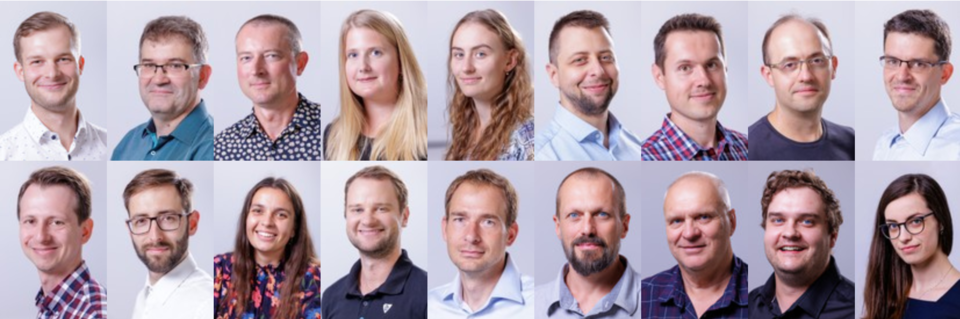
We are a team of scientists and developers working at the Department of Experimental Physics, Faculty of Science, Palacký University Olomouc.
Our mission and passion are the application and development of nuclear physics techniques, particularly Mössbauer spectroscopy. We draw on decades of experience in this field, dating back to the 1980s (see our list of publications). Sales of our spectrometers to universities and industry help finance further development and upgrades, enabling better research results and more advanced equipment for both our research and our customers.
Our team includes specialists in materials research and nanoscience, focusing on the synthesis of functional magnetic particles, including iron ferrites and iron oxides, as well as plasmonic structures and metal-organic frameworks. We also benefit from close cooperation with chemistry departments at our university and institutions abroad.
Our work is not limited to the development of standard equipment. We are also active in nuclear quantum optics using a radioactive source of 57Co, with research focused on polarized Mössbauer spectroscopy, single-photon entanglement and photon nonlocality.
All these activities drive us to continually optimize and improve our instruments, keeping them up to date and at the forefront of current scientific knowledge.
In addition to our equipment, we offer custom development of instruments and measurement procedures, as well as scientific collaboration.
Our team
Development
|
| ||||
|
| ||||
|
|






Theory
|
|


Materials Research
|
| ||||
|
|




Applications
|
| ||||
|
|




Contact us
For enquiries regarding our research, instruments, custom development or scientific collaboration, please contact us.
Address Department of Experimental Physics Office: 4th floor, left wing |
Publications
Nuclear Quantum Optics
-
Stejskal, A.; Vrba, V.; Procházka, V.: Toward flexible intensity control of resonantly scattered γ-rays using multi-frequency vibrating resonant absorber. Applied Physics Letters 126, 084102 (2025). doi:10.1063/5.0249167
-
Vrba, V.; Hausner, M.; Stejskal, A.; Procházka, V.: Acoustically controlled periodic gamma-optical signals described by semiclassical theory. Physical Review Research 7, 023243 (2025). doi:10.1103/l33j-xstp
-
Hausner, M.; Procházka, V.; Vrba, V.: Stimulated emission and coherent control of gamma photons described by quantum mechanical model. Physical Review Research 7, 023229 (2025). doi:10.1103/PhysRevResearch.7.023229
Materials Research
-
Václavek, L.; Tomáštík, J.; Nožka, L.; Procházka, V.; Lisníková, S.; Čtvrtlík, R.: Mechanical and optical properties of HfO₂ thin films prepared by evaporation with ion-assisted deposition. Materials Today Communications 49, 114125 (2025). doi:10.1016/j.mtcomm.2025.114125
-
Kořenek, M.; Ivanova, T.; Heger, V.; Dočkal, K.; Mašláň, M.: Impact of surface roughness and additive manufacturing-induced structural defects on oxidation of 316L stainless steel. Journal of Materials Research and Technology 39, 6823–6834 (2025). doi:10.1016/j.jmrt.2025.11.019
-
Ivanova, T.; Kořenek, M.; Mašláň, M.: Using Mössbauer Spectroscopy to Evaluate the Influence of Heat Treatment on the Surface Characteristics of Additive Manufactured 316L Stainless Steel. Materials 17, 3494 (2024). doi:10.3390/ma17143494
-
Ochmann, M.; Machala, L.; Mašláň, M.; Heger, V.; Krátký, T.: Zinc Ferrite Nanoparticle Coatings on Austenitic Alloy Steel. Materials 17, 857 (2024). doi:10.3390/ma17040857
-
Bilovol, V.; Żukrowski, J.; Sikora, M.; Novák, P.; Berent, K.; Rybicki, D.: Low-temperature Mössbauer spectroscopy: Evaluation of cation distribution in CoFe₂O₄. Journal of Molecular Structure 1305, 137780 (2024). doi:10.1016/j.molstruc.2024.137780
-
Stichleutner, S.; et al.: Change in Superparamagnetic State Induced by Swift Heavy Ion Irradiation in Nano-Maghemite. Metals 14, 421 (2024). doi:10.3390/met14040421
-
Lisníková, S.; Novák, P.; Kopp, J.: Nickel–iron and zinc–iron bimetal oxalates: preparation, characterization and thermal decomposition to spinel ferrites. Chemical Papers 78, 1–12 (2024). doi:10.1007/s11696-023-03047-0
-
Kořenek, M.; Ivanova, T.; Svačinová, V.; Mašláň, M.: Mössbauer Study on the Conversion of Different Iron-Based Catalysts Used in Carbon Nanotube Synthesis. Nanomaterials 13, 3010 (2023). doi:10.3390/nano13233010
-
Gracheva, M.; et al.: Revealing the nuclearity of iron citrate complexes at biologically relevant conditions. Biometals 37, 461–475 (2023). doi:10.1007/s10534-023-00562-1
-
Bilovol, V.; et al.: Occupancies of tetra- and octahedral sites in CoFe₂O₄ nanoparticles: The effect of the sintering temperature. Journal of Applied Physics 134, 094304 (2023). doi:10.1063/5.0163166
-
Kamilya, S.; et al.: Near Room Temperature Stepwise Spin State Switching and Photomagnetic Effect in a Mixed-Valence Molecular Square. Dalton Transactions 52, 10700 (2023). doi:10.1039/d3dt01615c
-
Kamilya, S.; et al.: ON/OFF Photo(switching) with Reversible Spin-State Change in a Mixed-Valence Fe(II)Fe(III) System. Inorganic Chemistry 62, 8794–8802 (2023). doi:10.1021/acs.inorgchem.2c03972
-
Skoumal, V.; Pechoušek, J.; Paralı, L.; Koç, M.: Affordable and customizable electrospinning set-up based on 3D printed components. Physica Scripta 99, 071501 (2024). doi:10.1088/1402-4896/ad5151
-
Lisníková, S.; Novák, P.: Systematic Study on MIL-100(Fe) Synthesis Conditions to Enhance Its Properties as a Green Material for CO₂ Capture. ACS Omega 10, 33461–33470 (2025). doi:10.1021/acsomega.5c03761
-
Hermossilla, D.; et al.: Environmentally friendly synthesized ferrite photocatalysts for wastewater treatment. Journal of Hazardous Materials 381, 121200 (2019). doi:10.1016/j.jhazmat.2019.121200
Development
-
Stejskal, A.; et al.: A dual Mössbauer spectrometer for material research, coincidence experiments and nuclear quantum optics. Measurement 215, 112850 (2023). doi:10.1016/j.measurement.2023.112850
-
Novák, P.; et al.: Lamb–Mössbauer factor of powders determined by Mössbauer spectroscopy with resonant detector. Chemical Papers 77, 7283–7288 (2023). doi:10.1007/s11696-023-02844-x
-
Kočiščák, J.; et al.: High time and energy resolution semi-transparent scintillation detectors for γ optics and Mössbauer spectroscopy. Measurement 206, 112225 (2022). doi:10.1016/j.measurement.2022.112225
-
Procházka, V.; et al.: Lamb-Mössbauer factor determination by resonant Mössbauer spectrometer. Physics Letters A 442, 128195 (2022). doi:10.1016/j.physleta.2022.128195
-
Kočiščák, J.; et al.: Properties of focusing polycapillary utilized in ⁵⁷Fe Mössbauer spectroscopy. Measurement 192, 110842 (2022). doi:10.1016/j.measurement.2022.110842
-
Kouřil, L.; et al.: Improvement of gas proportional counter performance in Mössbauer spectroscopy. NIM B 511, 75–83 (2021). doi:10.1016/j.nimb.2021.11.017
-
Procházka, V.; et al.: Autotuning procedure for energy modulation in Mössbauer spectroscopy. NIM B 483, 55–62 (2020). doi:10.1016/j.nimb.2020.08.015
-
Stejskal, A.; et al.: Mössbauer spectrometer designed for measurements of fast processes. NIM A 984, 164597 (2020). doi:10.1016/j.nima.2020.164597
-
Pechoušek, J.; et al.: Austenitemeter – Mössbauer spectrometer for rapid determination of residual austenite in steels. Measurement 131, 671–676 (2018). doi:10.1016/j.measurement.2018.09.028
-
Zyabkin, D. V.; et al.: Electrolytic cell-free ⁵⁷Co deposition for emission Mössbauer spectroscopy. Radiation Physics and Chemistry 146, 86–90 (2018). doi:10.1016/j.radphyschem.2018.01.016